
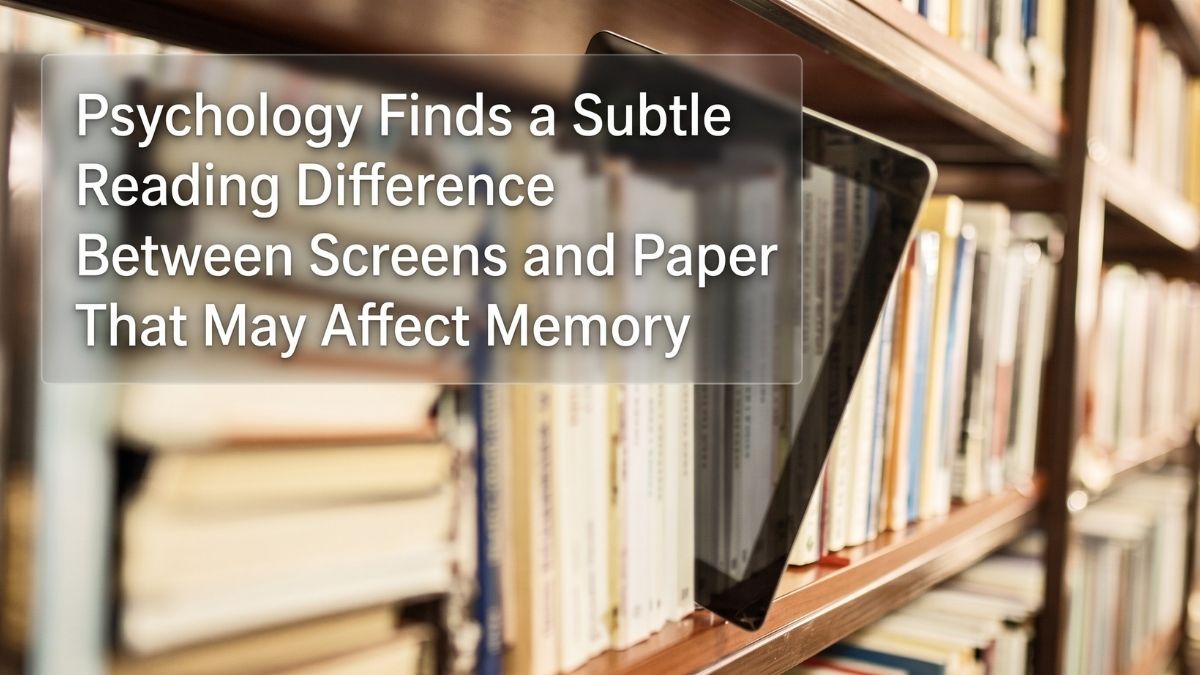
Reading on a phone, laptop or tablet has become routine. News articles, textbooks, work reports and novels are now commonly consumed on glowing screens rather than printed pages. Yet psychology and reading research suggests that the medium can influence how people process and remember information.
This does not mean digital text is automatically harder to understand. In many everyday situations, people comprehend screen-based material without difficulty. However, studies comparing digital and paper reading have found a modest advantage for printed material, particularly when readers are dealing with longer, more complex texts or working under time pressure.
Clues
One possible explanation involves something surprisingly basic: physical location.
In a printed book, every paragraph occupies a stable position. A reader may remember that an important idea appeared near the bottom of a particular page or that another detail was several pages earlier. These spatial features can become part of the memory associated with the text.
Screens provide a less stable physical map. Scrolling moves information, previous sections disappear from view and the reader may have fewer visual cues indicating where a particular idea appeared.
A 2018 meta-analysis by Pablo Delgado, Cristina Vargas, Rakefet Ackerman and Ladislao Salmerón examined 54 studies involving 171,055 participants. Overall, the researchers found a small comprehension advantage for paper compared with digital reading.
The difference became more noticeable when readers were under time pressure, suggesting that the way information is presented may become more important when people have less time to process it.
Skimming
Digital devices are also commonly used in ways that encourage rapid reading. A person may move between headlines, emails, social media posts, links and short articles within minutes.
Over time, that environment can encourage readers to scan for important information rather than carefully process every sentence.
Marte Blikstad-Balas, a professor at the University of Oslo, has examined this behavior in educational settings. In one study, eighth-grade students read informational material about a walrus and a beetle either on paper or a screen while wearing eye-tracking glasses.
Students reading on screens generally moved through the material more quickly and showed more signs of skimming. Their reading comprehension was also lower, while they returned to earlier sections of the text more frequently.
The students themselves did not appear to recognize the difference. They generally believed their performance was similar regardless of the medium, although the researchers observed differences in their reading behavior.
Memory
The screen-versus-paper effect is relatively small, and it should not be treated as a universal rule.
Ladislao Salmerón, whose research focuses on how digitization affects reading, has pointed out that the difference can be modest in an individual assessment. For example, if a test contains 10 questions, the average difference may amount to only about half a question.
That small effect can still be relevant when considered across years of reading and learning. Reading is a skill that develops through repeated practice, so subtle differences in how people approach information may accumulate over time.
A 2023 systematic review by Igor Peras and colleagues found mixed evidence among students aged 6 to 18. Some studies found no meaningful difference between paper and screens, while others reported lower comprehension with digital reading.
The researchers also highlighted other factors, including previous reading ability, reading habits, family resources and the way technology is used in schools.
Context
The type of material being read appears to matter. The potential disadvantage associated with digital reading may be smaller for narrative content, such as novels, than for informational or explanatory material that requires readers to retain and connect multiple details.
This distinction is important because reading a novel for enjoyment is different from studying a complicated chapter for an examination.
A reader who is casually browsing an article may not need to remember every detail. In contrast, someone learning a scientific concept may benefit from slowing down, revisiting difficult sections and keeping track of how different ideas fit together.
The medium is therefore only one part of the reading experience.
Habits
Screens are not inherently poor reading tools. They offer convenience, portability and access to vast amounts of information. For many people, digital devices also make reading possible in situations where carrying printed material would be impractical.
The more useful approach may be to adjust reading habits according to the goal.
For quick information, skimming can be efficient. For studying or understanding complicated material, readers can deliberately slow their pace, avoid unnecessary notifications and revisit important sections. Taking notes can also provide additional memory cues that compensate for some of the physical landmarks available naturally in printed books.
The research ultimately suggests that the words themselves are only part of the reading experience. Paper provides stable physical and spatial cues, while screens often encourage faster and more flexible movement through information. These differences may influence comprehension and memory, particularly during demanding reading tasks. Digital reading remains an effective tool, but when the goal is deep understanding, the way we read may matter as much as where we read.
FAQs
Is paper reading better than screen reading?
Research shows a small comprehension advantage for paper in some situations.
Why can paper help memory?
Stable page locations can provide useful physical and spatial memory cues.
Does screen reading encourage skimming?
Some research suggests people tend to read digital text faster and skim more.
Are screens bad for reading?
No. Digital reading can be effective, especially for shorter or simpler texts.
Does reading speed affect comprehension?
Reading too quickly may make it harder to process complex information deeply.