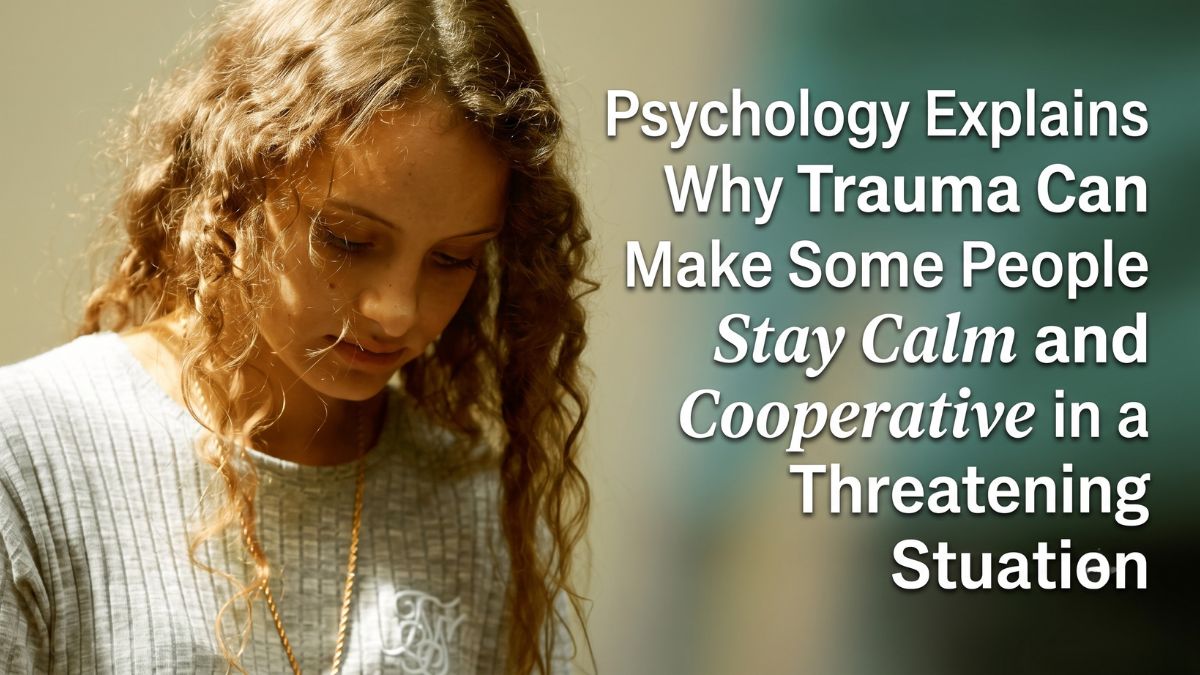
When people think about how humans respond to danger, the usual picture is straightforward: fight the threat, run away or freeze in place. But psychology shows that trauma responses can be more varied than these familiar reactions suggest.
In some threatening situations, a person may remain calm, cooperate with the other person, avoid confrontation or even behave as though everything is normal. From the outside, that reaction can be difficult to understand. Why would someone cooperate with a person they fear?
One possible explanation is the lesser-known “fawn response,” a term used to describe a pattern of appeasing or accommodating a perceived threat. It is often discussed in trauma-informed psychology as a way some people may attempt to reduce conflict and maintain a sense of safety.
The response is important because outward calm does not necessarily mean that a person felt safe or comfortable. Trauma can influence both behavior and memory in ways that may not match common expectations about what fear should look like.
Fawning
The best-known responses to danger are often described as fight, flight and freeze. Fight involves confronting the threat, while flight involves trying to escape. Freeze can involve becoming unable to move, speak or take immediate action.
Fawning represents another possible pattern. Instead of confronting the threat or attempting to escape physically, a person may try to make the situation less dangerous by being agreeable, accommodating or compliant.
Psychologist Michele Patterson Ford, a lecturer at Dickinson College, discussed this type of response in an article published by Scientific American. She explains that people experiencing trauma may respond in ways that outsiders do not immediately recognize as fear, including remaining calm or attempting to appease someone perceived as threatening.
The behavior can therefore be understood as an attempt to manage danger rather than as evidence that the person welcomed what was happening.
Cooperation
One of the more confusing aspects of trauma is that a person’s behavior during an event may appear inconsistent with what observers expect fear to look like.
For example, someone experiencing a frightening situation during a professional appointment might continue with the appointment, pay and leave normally rather than abruptly confronting the person or running away.
An observer might interpret that behavior as evidence that nothing serious happened. A trauma-informed perspective considers another possibility: maintaining the routine may have felt like the safest available option.
In this context, cooperation can function as a form of de-escalation. Rather than physically escaping, the person may attempt to avoid provoking the perceived threat by remaining calm and accommodating.
Memory
Trauma can also complicate how people remember distressing experiences.
People often imagine memory as a recording that can be replayed from beginning to end. However, memories are reconstructed by the brain, and highly stressful experiences can be remembered differently from ordinary events.
Ford’s Scientific American discussion notes the roles of brain systems including the hippocampus, which is involved in memory, and the amygdala, which plays an important role in emotional processing. Extreme stress can affect how an experience is processed and later recalled.
A person may therefore remember particular sensations, sounds, smells, images or emotions without having a complete chronological narrative.
For example, someone might clearly remember a particular sound or physical sensation while struggling to explain exactly what happened immediately before or afterward. An incomplete or fragmented account does not, by itself, establish that the experience did not occur.
Triggers
Another feature of trauma is that reminders of a past event can sometimes produce a strong emotional reaction in the present.
Ordinary memories usually come with a clear sense that something happened in the past. Traumatic recollections can sometimes feel more immediate. A smell, sound, image, physical sensation or situation resembling the original experience may bring back an intense emotional or bodily response.
This can make it difficult for someone to separate the emotional intensity of a past experience from what is happening in the present moment.
Previous trauma can also influence how someone responds to a later threatening situation. A new experience may activate associations with an earlier event, potentially affecting both the person’s immediate behavior and their later recollection.
Misunderstanding
These reactions can be misunderstood because society often expects visible signs of distress after frightening experiences.
People may assume that someone who stayed calm was not frightened, that someone who cooperated consented to what happened or that someone whose memory is incomplete must be unreliable.
Those assumptions are too simple.
A person can respond to danger by attempting to keep the situation calm. Someone may also continue with ordinary activities because maintaining a routine feels safer than confronting the circumstances directly.
At the same time, not every instance of cooperation, calmness or incomplete memory should automatically be labeled a trauma response. Human behavior is complex, and the circumstances surrounding an event matter.
Understanding
The idea of a fawn response provides another way to think about survival behavior. Not every person responds to danger by fighting or running. Some may become still, while others may try to reduce the threat by appearing agreeable and avoiding confrontation.
Knowing these possibilities does not mean assigning a trauma explanation to every unusual reaction. Instead, it encourages a more careful approach to behavior that may initially seem confusing.
Trauma-informed psychology emphasizes context and avoids judging a person’s experience solely by how their behavior looked from the outside. A calm response does not necessarily indicate an absence of fear, just as cooperation does not automatically tell us how someone felt internally. Looking at the broader circumstances can provide a more accurate understanding of how people respond to threatening experiences.
FAQs
What is the fawn response?
It involves appeasing or accommodating a perceived threat.
Is fawning a trauma response?
It can be a way some people attempt to manage perceived danger.
Why might trauma memories feel fragmented?

Extreme stress can affect how experiences are processed and recalled.
Can trauma make the past feel present?
Yes, reminders can sometimes trigger intense reactions in the present.
Does calm behavior mean someone felt safe?
No. Calm behavior does not necessarily reveal a person’s internal state.