
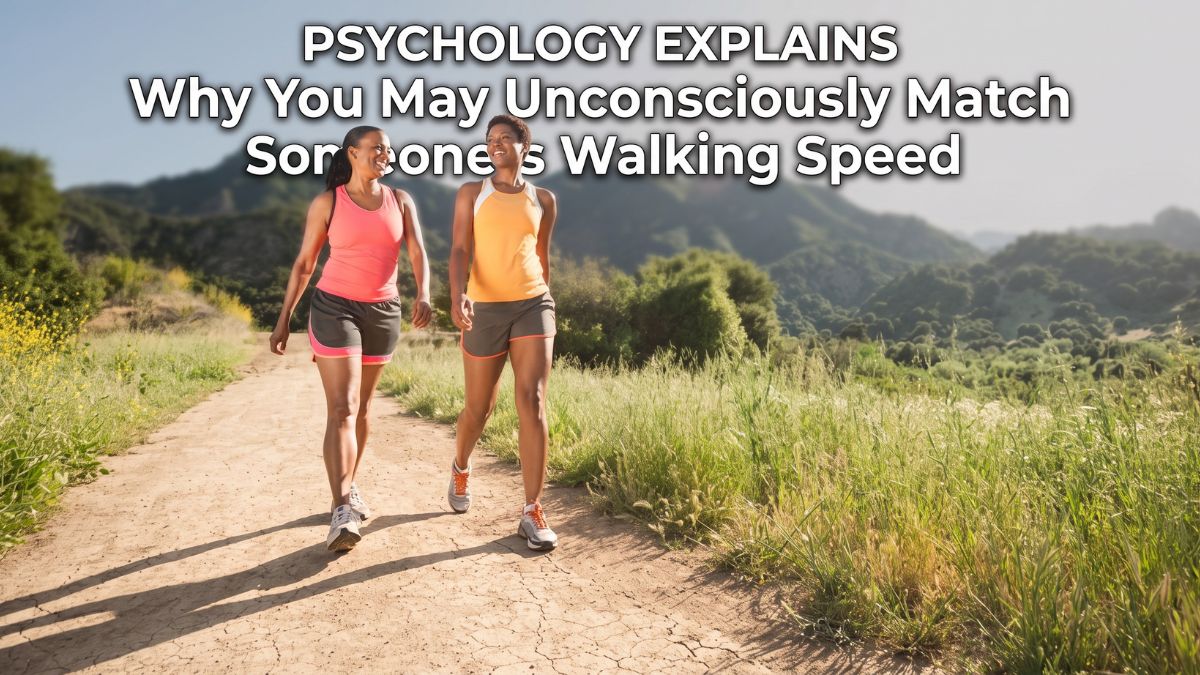
Have you ever started walking beside someone and noticed later that your pace had changed? Perhaps you normally walk quickly but gradually slowed down to stay alongside them. Or maybe you found yourself walking faster because the other person was moving ahead.
Neither person necessarily makes a conscious decision to coordinate. Yet after a short time, their steps can begin following a similar rhythm.
Psychology and movement science describe this as a possible example of interpersonal synchrony, a broad phenomenon in which people coordinate movements, timing or other physiological processes during social interaction. Research specifically examining human gait has found evidence that people can spontaneously synchronize aspects of their walking, particularly when moving side by side.
This does not mean that matching someone’s walking speed automatically indicates attraction, friendship or emotional closeness. There are many ordinary reasons for the behavior. Instead, it offers a small example of how people can unconsciously adapt their movements to those around them.
Synchrony
Walking may appear to be an entirely individual activity. Everyone has a preferred pace, stride length and walking rhythm. But when two people travel together, their movements do not always remain completely independent.
A systematic review examining spontaneous interpersonal synchronization of gait included 16 studies and found evidence that people can spontaneously synchronize aspects of walking, particularly when they move alongside one another.
The extent of synchronization varied according to the sensory information available to participants.
This makes sense from a behavioral perspective. When walking beside someone, you can see their body movements, hear their footsteps and notice changes in the distance between you. Your movement system is constantly receiving information about another person’s pace, creating opportunities for subtle adjustments.
Behavior
Interpersonal synchrony refers broadly to the alignment of behavior or physiological activity between people during interaction.
Psychologists have studied different forms of behavioral coordination, including the ways people unconsciously imitate movements, match conversational rhythms or coordinate their actions during shared activities.
A recent integrated review by Emily E. Cross and colleagues describes interpersonal synchrony as alignment between people across different behaviors. Research has considered several possible functions of this coordination, including making joint activities easier and supporting social connection.
Walking provides an especially clear example because it combines physical movement with social interaction. Two people can be talking while simultaneously adjusting their movements to remain together.
Pace
Consider a simple situation. You are walking through a park with a friend who normally walks slightly faster than you.
At first, your friend moves a little ahead. Without consciously deciding to change your pace, you begin taking quicker steps. Your friend may also slow down slightly. Eventually, you are walking next to each other again.
This can be understood as interpersonal coordination.
The nervous system continuously processes information about the surrounding environment and the movements of other people. When two people engage in the same rhythmic activity, their movements can become connected through visual and auditory information.
Researchers studying side-by-side walking have observed episodes of spontaneous frequency and phase coordination even when participants were not instructed to synchronize their steps.
In other words, coordination does not always require deliberate imitation.
Sensory
The senses play an important role in this process.
When you walk beside another person, you can see when they speed up or slow down. You may hear their footsteps and notice whether the distance between you is increasing or decreasing.
This creates a continuous feedback loop. Your brain receives information about the other person’s movement and can make small adjustments to your own movement.
The systematic review of spontaneous gait synchronization found that the availability of sensory information affected how synchronization emerged.
That may help explain why walking synchrony is particularly noticeable when people are close together and moving in the same direction.
Social
Synchrony is not necessarily only a mechanical response to movement.
Psychological research has also examined whether coordinated behavior can influence social interaction. A meta-analysis by Reneeta Mogan, Ronald Fischer and Joseph Bulbulia examined 42 independent studies involving more than 4,000 participants.
The researchers found associations between experimentally induced synchrony and outcomes such as prosocial behavior, social bonding and positive affect.
However, this evidence needs to be interpreted carefully. It does not mean that two people who happen to walk at the same speed will automatically develop a stronger relationship.
Experimental synchrony and naturally occurring walking synchronization are not exactly the same phenomenon.
Attraction
Matching another person’s walking speed is sometimes interpreted as a possible sign of attraction. Psychology does not provide enough evidence to make that conclusion from walking pace alone.
There are many straightforward explanations for why two people synchronize their steps.
They may be friends walking to the same destination. They may be colleagues heading to a meeting. One person may simply be trying not to lose the other in a crowded area. Their natural walking speeds may also happen to become similar.
Research on natural walking has found that synchronized walking can occur more often than would be expected by chance. It has also examined how walking synchronization and conversation can independently influence interpersonal impressions.
So synchrony can have social relevance without functioning as a hidden romantic signal.
Coordination
There is also a practical reason people may adjust their walking pace.
Imagine two people trying to have a conversation while one consistently walks several steps ahead. The other person repeatedly has to speed up to catch up. The distance keeps changing, and maintaining the interaction becomes more difficult.
Matching pace solves that problem without requiring either person to say anything.
This fits with broader theories suggesting that interpersonal synchrony can make shared activities easier and reduce the effort involved in coordinating behavior.
Sometimes, therefore, synchronization may simply be an efficient way for two people to move together.
Connection
Once people begin moving at a similar rhythm, the interaction may also feel more coordinated.
Shared timing is present in many human activities, including dancing, singing, marching and group exercise. Research on interpersonal synchrony has explored connections between coordinated movement, affiliation, cooperation and social bonding.
Meta-analytic evidence suggests that synchrony can have positive effects on prosocial behavior and perceived social connection under certain conditions.
That does not mean every synchronized movement creates a meaningful bond. Context remains important. But coordinated behavior can become part of how people experience an interaction.
Awareness
One reason behavioral synchrony is interesting is that people may not notice themselves doing it.
You probably do not think, “I should now synchronize my walking rhythm with this person.” Instead, small adjustments occur over time.
Your stride changes slightly. The other person’s pace changes as well. The distance between you becomes more stable, and eventually you are moving at a similar speed.
Researchers distinguish between coordination that people are explicitly instructed to perform and spontaneous coordination that emerges without such instructions. Walking studies provide examples of the latter.
The lack of conscious planning is part of what makes the behavior worth studying.
Context
Synchrony should not automatically be treated as evidence of closeness.
An integrated review of interpersonal synchrony has emphasized that coordinated behavior can serve different purposes depending on the situation. Effective synchronization also needs to adapt to the goal of an interaction.
Two strangers may synchronize their steps briefly because they are walking through the same space. A person may slow down to remain alongside an elderly companion. Someone may speed up simply because the group is approaching a destination.
The same outward behavior can therefore have very different explanations.
Adaptation
The broader lesson is that human behavior is remarkably responsive to other people.
We adjust the rhythm of conversations, alter our movements in crowded spaces and sometimes imitate gestures without intending to. Walking pace can be another example of this flexibility.
The person beside you becomes part of your movement environment. Your brain receives information about their pace and position, and your body can respond with small adjustments.
Unconsciously matching someone’s walking speed therefore does not provide a reliable psychological code for determining attraction or emotional closeness. It does, however, illustrate how people can spontaneously coordinate their movements during social interaction.
Research on gait synchronization shows that walking patterns can become aligned without deliberate instructions, while broader research suggests that synchrony can support cooperation and social connection in appropriate contexts. Sometimes the behavior is social, sometimes practical and sometimes simply a natural consequence of two people moving together. The important point is that our bodies, like our conversations, can quietly adapt to the people around us.
FAQs
Why do people match walking speeds?
Sensory information can encourage people to adjust their pace.
Is walking synchrony always conscious?
No. Research shows it can occur without deliberate instructions.
Does matching pace mean attraction?
No. Walking pace alone cannot establish romantic interest.
What is interpersonal synchrony?
It is the alignment of behaviors or rhythms between people.
Can synchrony support social bonding?
Research suggests synchrony can support connection in some contexts.