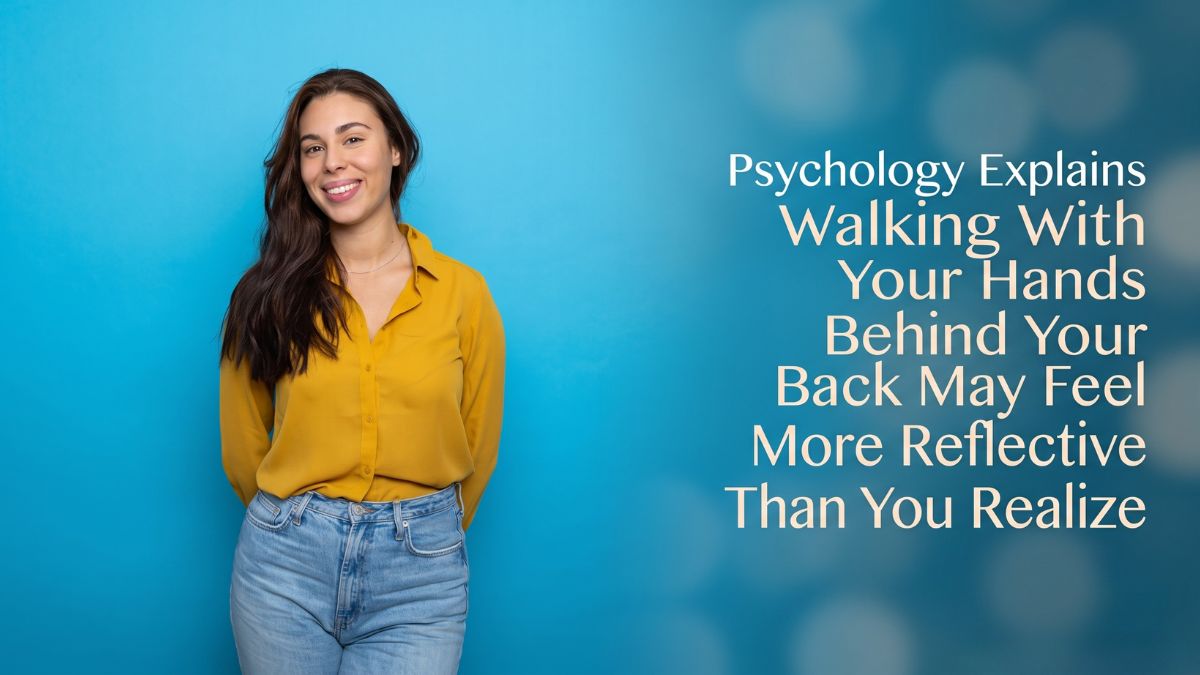
Have you ever noticed someone walking with their hands loosely held behind their back, moving at an unhurried pace? You might see the posture during a quiet walk, a museum visit, or while someone appears to be thinking through a problem.
It is tempting to assign a meaning to the gesture. Perhaps the person is calm, reflective, or deeply focused. But psychology offers a more cautious explanation. A single posture cannot reliably reveal someone’s personality, mood, or intentions. Context, movement, facial expression, individual habits, and the surrounding situation all matter.
Still, there are interesting reasons why this particular posture can sometimes accompany quiet reflection. The explanation may involve the way walking affects thinking, how the brain monitors the position of the body, and how people interpret posture.
Movement
Putting your hands behind your back changes the way you move.
Your hands are no longer naturally swinging at your sides, and you are less likely to gesture while walking. For some people, this can make the movement feel more contained and deliberate.
Researchers Helge Gillmeister and Bettina Forster at the University of Essex studied how different positions of the hands behind the back affect the brain’s processing of touch. Their work involved blindfolded participants whose hands were positioned close together or farther apart.
The research was not designed to determine whether people with their hands behind their backs are thoughtful or calm. Instead, it showed that the position of the arms can influence how the brain processes information about the body.
This relates to proprioception, the body’s ability to sense where its limbs are positioned without relying on vision. In other words, your brain is constantly monitoring where your arms, legs, and other body parts are.
The posture may therefore change the physical experience of walking, but that does not mean it carries one universal psychological meaning.
Walking
The connection with reflection may have more to do with walking itself than with the hands.
Research by Marily Oppezzo and Daniel Schwartz at Stanford University found that participants produced substantially more creative responses while walking than while sitting. Across four studies involving 176 college students and other adults, walking increased creative output by about 60 percent in the tested conditions.
The effect was found during both indoor and outdoor walking.
However, walking did not improve every type of thinking. The researchers found that it was particularly useful for generating divergent ideas, where several possible answers can be considered. It was not necessarily helpful for tasks requiring a single correct response.
That distinction is important. A walk may help someone explore possibilities, reconsider a problem, or generate ideas, but it is not a universal method for improving concentration.
This may help explain why walking is often associated with thinking. Many people naturally walk while talking through a problem or trying to organize their thoughts.
Posture
The hands are only one part of body language.
People perceive posture by combining information from the head, shoulders, arms, legs, facial expression, movement, and surrounding circumstances. Research on emotional body movement has shown that these different signals contribute to how observers interpret another person’s state.
A person walking upright with relaxed shoulders, a steady pace, and loosely held hands behind their back may appear calm or composed.
Change those other signals, however, and the impression can change.
A person with tense shoulders, a lowered head, rigid fingers, and a slow pace may appear worried or uncomfortable even though their hands are in exactly the same position.
Research by Lotte Veenstra and colleagues at Vrije Universiteit Amsterdam also explored how body posture relates to mood. Across two studies involving 229 and 122 participants, respectively, people adopting a hunched posture showed differences in mood recovery and negative thinking compared with people using more upright or neutral postures.
That research does not establish that a particular walking posture creates calmness. It does suggest that the relationship between posture and psychological experience is worth considering.
Reflection
Why, then, can hands behind the back sometimes look reflective?
Part of the answer may be visual. The posture reduces obvious hand movement and can make the person’s walk appear more deliberate. When combined with a slower pace and relaxed body language, it can create an impression of someone who is not focused on immediate action.
Imagine someone walking through a museum with their hands clasped behind them. They stop occasionally, look at an artwork, and continue at a slow pace.
The entire scene encourages an interpretation of quiet observation.
But the same person could use the posture simply because it feels comfortable.
The context changes the meaning.
Habits
A person’s habits may be more important than outsiders realize.
Someone might regularly walk with their hands behind their back because they learned the posture at work. A teacher, security professional, museum visitor, or older adult may have adopted it through repeated experience.
Another person may use the position because they do not know what to do with their hands. Someone else may be avoiding reaching for their phone.
It could also provide a simple stretch or reduce unnecessary arm movement.
This is why psychological interpretations of body language need to remain tentative. The same gesture can emerge from completely different reasons.
Context
Other details can change how a posture is interpreted.
Consider someone looking toward the ground while walking. They could be thinking, feeling tired, navigating an uneven surface, or simply watching where they are stepping.
Likewise, someone holding one wrist tightly behind their back may appear tense. But the person could just be standing in a familiar position.
Walking speed can also be misleading. It is often assumed that anxious people automatically move quickly, yet research does not support such a simple rule. Some studies have found slower walking patterns among people experiencing anxiety.
This illustrates an important point: psychological states can influence movement, but movement does not provide a straightforward reverse diagnosis of psychological states.
Signals
Body language is often treated as though every gesture has a fixed translation.
Research does not support that idea.
A 2023 review by Miles L. Patterson, Alan J. Fridlund, and Carlos Crivelli examined the broader evidence surrounding nonverbal behavior and argued against treating body language as a simple code that can be decoded gesture by gesture.
That does not mean body language is meaningless. Instead, its interpretation depends heavily on context.
A gesture is better understood as one piece of information rather than a definitive answer.
The person’s usual behavior, the environment, cultural expectations, physical comfort, and other visible signals all contribute to the interpretation.
Meaning
So, does walking with your hands behind your back indicate quiet reflection?
Sometimes it may accompany reflection, particularly when it appears alongside a slow pace, relaxed posture, and sustained attention to the surroundings. Walking itself may also support certain kinds of creative thinking and mental processing.
But the posture alone cannot establish what someone is thinking or feeling.
For one person, it may be a comfortable habit. For another, it may be associated with concentration. Someone else may simply be trying to keep their hands away from their phone.
Psychology is most useful here when it adds context rather than certainty. The next time you notice someone walking with their hands behind their back, it may be reasonable to wonder whether they are reflecting on something. It is not reasonable to assume the posture has already provided the answer.
FAQs
Why do people walk with hands behind their backs?
It can be a habit, comfortable posture, or part of quiet reflection.
Does this posture prove someone is thinking?
No. A single gesture cannot reliably reveal someone’s thoughts.
Can walking help creative thinking?
Research suggests walking can increase creative idea generation.
What is proprioception?
It is the body’s sense of where its limbs are positioned.
Can body language reveal personality?
Not reliably from one gesture; context and multiple signals matter.